Method
Diagnosis before recommendation.
Two methodologies, both written in practice. Measures are agreed at the outset rather than assembled at the end. Observation is separated from judgement, confidence is stated, and trade-offs are made explicit.
The consulting method
The Integrated Consulting Methodology carries strategy, governance and transition work. Five stages, each producing a document the client keeps, with alignment held across the whole engagement rather than asserted at the end.
Where the work is a programme
The Integrated Learning Methodology is the companion approach, used where the principal intervention is a programme, a convening or a learning process.
| Phase | Question it answers | Artefact |
|---|---|---|
| Assess | What is the situation, and what would count as evidence that it had changed | Assessment report and agreed measures |
| Design | What arrangement would produce that change, and what does each option commit the organisation to | Options paper with trade-offs stated |
| Deliver | What happens when the arrangement meets the organisation | Status reporting and adjustment record |
| Evaluate | What changed, measured against the standard set at the outset | Impact report |
| Measure | Runs through all four rather than following them | Instruments defined at Assess, collected throughout |
Phases are separable
Each phase produces something usable on its own. An organisation can commission Assess alone and receive an assessment report that stands whether or not the work continues. Commitment is staged rather than requested up front.
Analysis inside the phases
Within Assess and again within Evaluate, the analytical sequence is context, evidence, interpretation, implications, actions. Observation is separated from judgement. Confidence is stated for each finding. Where evidence supports more than one reading, both are presented rather than one selected.
This is the discipline that produces the trade-off framing and confidence tagging used in institution-wide strategy work.
Modules
These are instruments used within an engagement rather than the offer itself.
They sit at the boundaries between phases rather than inside them, so the decision to continue arrives at a visible point with a defined scope rather than through expanding an engagement already underway.
Modules have been delivered in Canada, the United Kingdom, Germany, Australia, New Zealand, Ethiopia and Malaysia, in person, blended and online. The lifecycle was developed while running a university executive education business delivering fifteen to twenty custom programmes a year, whose work received the Canadian Council on Learning Award for Excellence in Learning in 2009. It has been applied since across strategy, governance and venture work. Other instruments are drawn into the work where the agreed scope requires them. Where an engagement requires specialist expertise beyond the practice, that expertise is identified when scope is developed and brought into the work by name.
Designing an institution-wide strategy
Strategy for a university, college or public-purpose body is distinctive because responsibility for shaping, approving and giving effect to it is distributed across the institution. The following is the architecture the practice uses. It is method rather than client material.
Governance architecture before content
Before substantive choices are made, the governance architecture needs to be clear: who is responsible for what, how the work moves through the institution, what evidence informs it, and where decisions are finally made. A steering committee chaired by the head of the institution, working groups drawn from students, staff and faculty, a project office holding the analytical work, and a defined passage through academic governance to board approval. The architecture determines what the strategy is capable of committing to, so it is designed first and in writing.
Consultation designed as evidence
Protocols set out who is consulted on what, what is actually being asked, how responses are recorded, and how they enter the decision. Where consultation cannot change a decision, that is stated in advance rather than discovered afterwards.
Scanning against explicit horizons
Environmental scanning is structured across a near horizon, a planning horizon and a long horizon, using templates that separate observed conditions from projections and name the assumption behind each projection. An assumption that is never written down becomes a fact by default.
Choices framed as trade-offs
Strategic choices are put as explicit commitments with a stated cost, not as aspirations that avoid choosing. Where a choice is genuinely binary, it is framed as binary. Where choices cannot all be pursued at once, that is made visible rather than deferred.
Confidence stated, severity preserved
Every finding carries a stated level of confidence. As material moves up through working groups, steering committee and board, the severity of what was found is preserved rather than smoothed. Summarisation should not remove material differences, uncertainties or implications, so the rules for it are set at the start.
A hand-off register
Each phase closes with a written record of what has been committed, what remains open, what was considered and rejected and why, and who owns each item next. Institution-wide strategy takes years and outlasts the people who start it. The register is what allows the work to survive a change of personnel, including the departure of whoever is leading it.
Designing convenings and executive education
Conferences, executive programmes, board retreats and roundtables serve different purposes, but each benefits from being designed from the outcome backward. The starting point is what participants need to understand, consider, or be able to do differently as a result, and what evidence would show that this had happened. Composition, sequence, evidence, facilitation and follow-through follow from that.
Purpose before programme
The starting point is what the convening is intended to produce and what evidence would demonstrate that it had done so. The agenda, contributors, activities and follow-through are then designed around that purpose.
Composition is part of the design
Who is in the room shapes what the room can conclude, and that extends to contributors and faculty, who are selected against the question rather than for reputation alone. Selection covers seniority, the authority each participant actually holds, the interests that will collide, and who has to be present for a conclusion to stick once everyone has gone home.
Build the material from the organisation
Cases, simulations and scenarios developed from the client's own situation and data rather than adapted from a library. Participants recognise the problem, which is what makes the discussion usable rather than hypothetical.
Difference held rather than collapsed
Sessions run so that the perspectives, rights, responsibilities and interests around a question are made visible and not prematurely reduced to a single view. Disagreement is recorded rather than resolved on the participants' behalf. Where consensus is not available, the positions are documented as they stand.
Transfer designed before delivery
Follow-up sessions, action plans, coaching and measurement against the standard agreed at the outset. The barriers to application in the workplace are identified while the programme is being designed, not discovered in the evaluation.
Developed across an executive education business delivering fifteen to twenty custom programmes a year to government, healthcare, industry and professional services, national executive roundtables across financial institutions, utilities and Indigenous organisations, international field schools, and academic conference convening in Canada, South Africa and the United Kingdom.
Scope
Specialist expertise is brought in explicitly.
Where an engagement requires specialist expertise beyond the practice, that expertise is identified when the scope is developed and brought into the work by name.
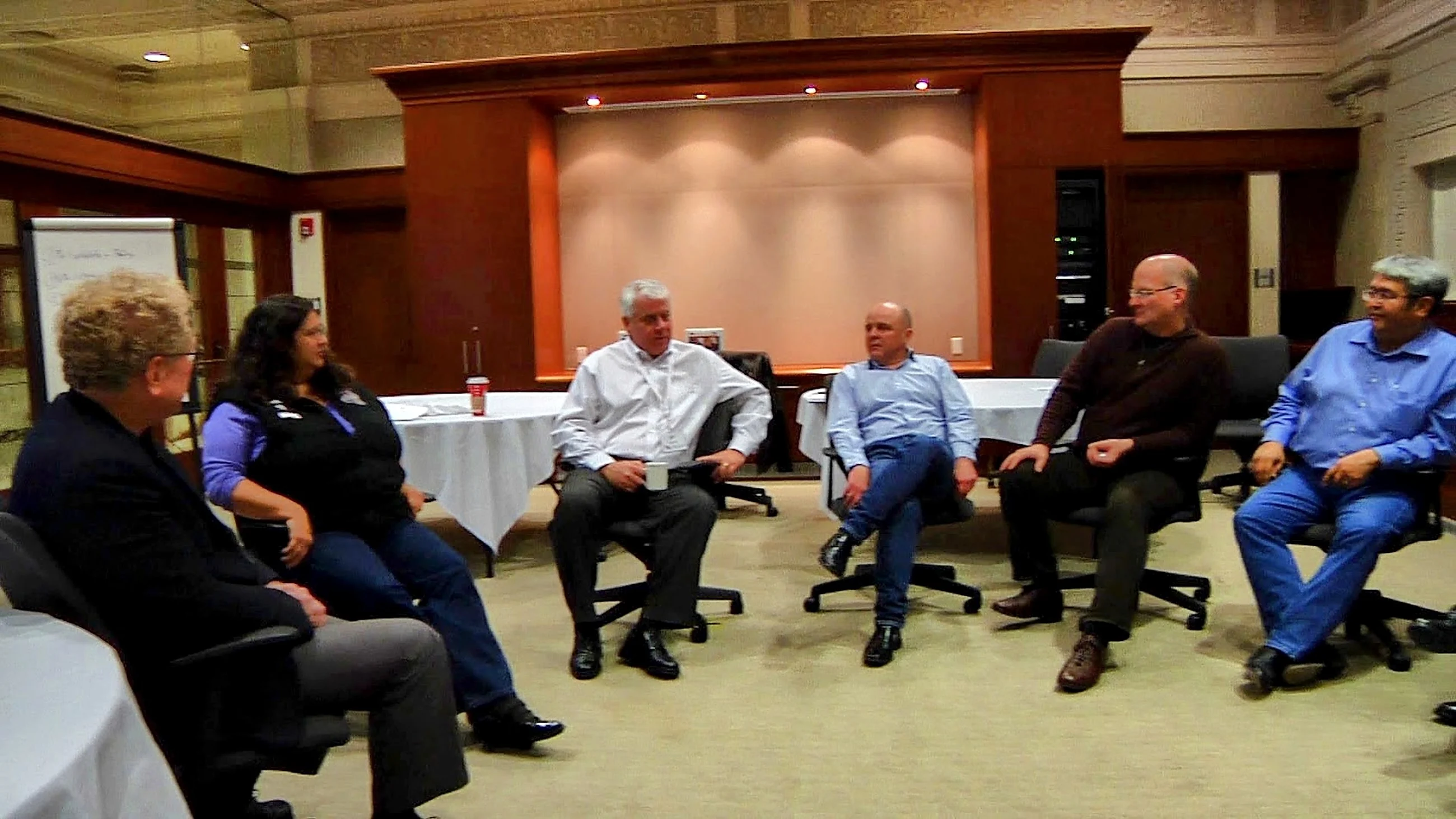
Roundtable, seated in the round with no head of the table.
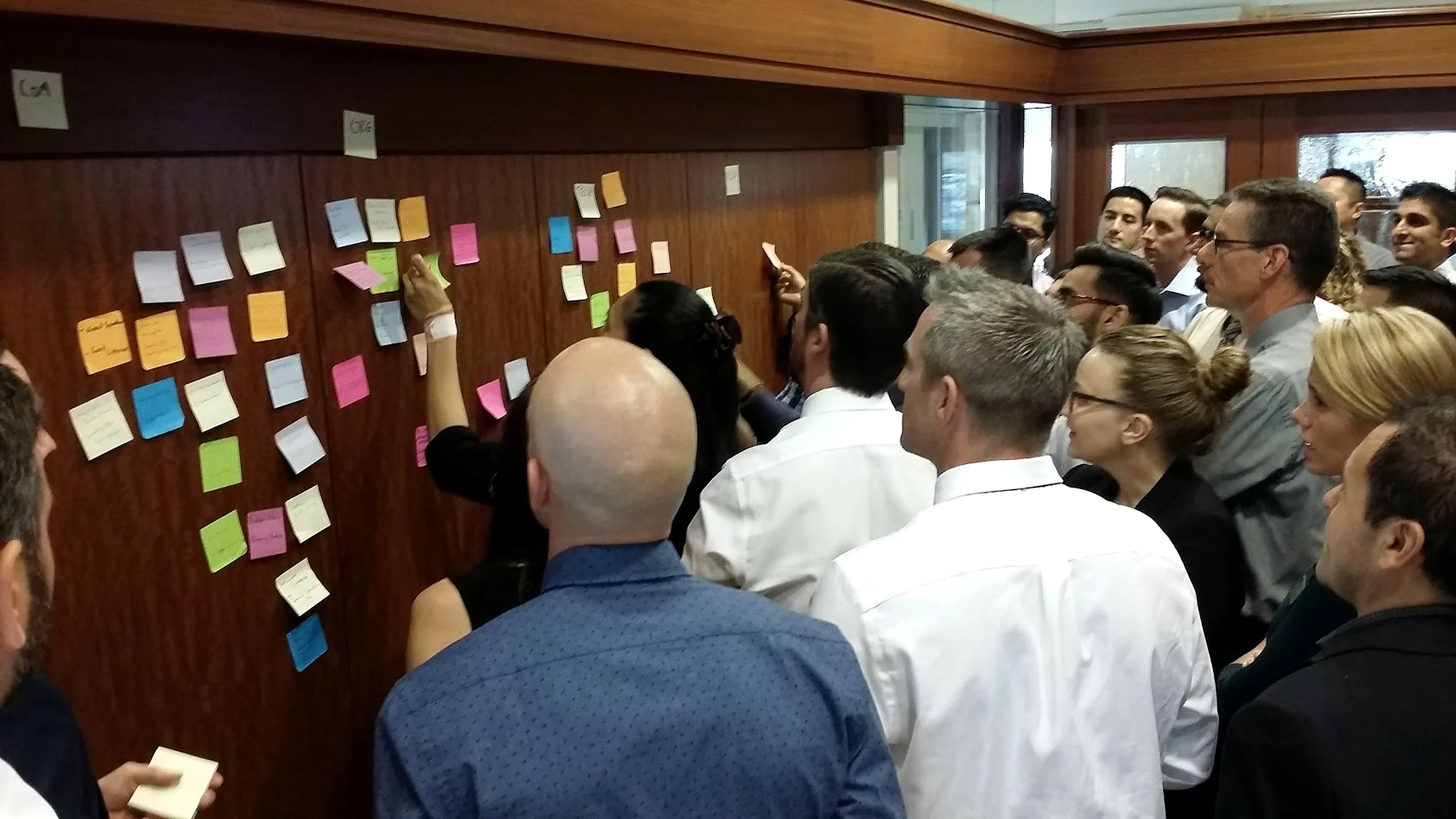
Working session, mapping and prioritising on paper.