
Praxis Global
Strategy and governance through change.
A principal-led practice working with organisations through periods of growth, transformation and strategic renewal. The work sits where strategy, governance and enterprise meet.
The situations
Consequential change rarely stays inside one part of an organisation.
A university setting its direction for the next two decades. A community-owned group whose revenue has grown fortyfold and whose governance has to grow with it. A pathway that no single institution holds, requiring independent organisations to work as one. Two organisations considering a shared infrastructure asset. A founder handing over to a management layer. A methodology held by one person that has to become something an organisation can run.
These situations differ in scale and setting, but each raises questions about direction, responsibility and how change will be carried forward. Growth creates new governance requirements. Strategic renewal requires choices that reach across established organisational boundaries. Partnerships bring together organisations and communities with different responsibilities, knowledge and interests. New ventures require decisions about ownership, operation and capital.
Praxis Global works with these conditions: establishing what needs to be understood, what choices need to be made, and the structures through which those choices can be carried forward.
Areas of work
Institutional and organisational strategy
Setting direction and building the process by which direction is set. Environmental analysis, strategic choice, consultation design, and the passage of a strategy through the governance that has to approve it.
Evidence
- 30,000 member university community engaged in a live institution-wide strategy, reporting to the President, with a project team of six
- CAD 2M executive education business run with full profit and loss accountability, fifteen to twenty custom programmes a year, a team of fourteen
- Five inaugural appointments in which the function did not previously exist, its team was recruited, and its governance was built
Governance and organisational change
Board and ownership arrangements, executive compensation, succession, and the governance requirements that growth and transition create. Particular depth in community-owned enterprise, Indigenous economic development corporations and private groups in transition.
Evidence
- $1M to $40M revenue growth across nine years of founding directorship, with governance developed alongside it
- Chair of a CEO compensation committee; member of audit and finance, strategy, and board renewal committees
- Three current board of directors appointments, and advisory board or committee appointments with a further dozen organisations over the record; ICD.D corporate director
- Faculty-wide hiring governance and search and selection frameworks designed and held across all permanent and contract appointments in a business school
Partnerships and convening
Building arrangements through which organisations, communities and other participants can work on a shared question or opportunity. Partnership development, executive education, roundtables, conferences, field schools and leadership exchanges.
Evidence
- Five institutional partnership agreements negotiated and executed, spanning universities in Australia and New Zealand and national organisations representing Indigenous, Black and LGBTQ2S+ business communities in Canada
- 25+ post-secondary institutions in a distributed education network built and led
- Nine African countries in a research and enterprise network convened with Canadian institutions
Venture and intellectual property
Taking methodology, research or expert practice and building the structure that allows it to operate independently of the person it came from. This can include the proposition, the operating model, ownership, product architecture, route to market and the relationship with capital.
Evidence
- CAD 100K first corporate deployment revenue for a methodology taken from concept to market
- Four methodologies codified and commercialised, two with institutional deployments
Ways of working
Three ways an organisation can engage the practice, rather than three separate businesses. Which one fits depends on how much of the work has to be held from inside the organisation and for how long.
Interim and fractional mandates
Holding a named executive or institutional role inside an organisation for a defined period, with explicit authority, reporting line and outcomes. A strategy or transformation lead, an interim academic or executive post, or the lead for a defined institutional process.
Suited to a strategy renewal, a merger or integration, a move to a new operating model, a founder handing over to a management layer, or a function that has to be built before anyone can run it. Two concurrent mandates is the realistic limit.
Non-executive and board appointments
Board seats where the questions are strategy, executive compensation, succession, capital allocation, growth, and the relationship between ownership and management.
Growth creates new governance requirements. So do changes in ownership, the arrival of a management layer, and the adoption of technologies that raise new questions of responsibility, risk and capability. Particular fit where an organisation's licence to operate depends on its relationships with communities, Rightsholders or regulators.
Defined engagements
A piece of work with a stated question, an agreed scope and named artefacts. Diagnosis, design, facilitation, evaluation, and the commercialisation of methodology.
Also the design and delivery of convenings: executive education, roundtables, conferences, field schools, leadership development and corporate storytelling. Each phase produces something usable on its own and can be commissioned alone.
Where the work has been
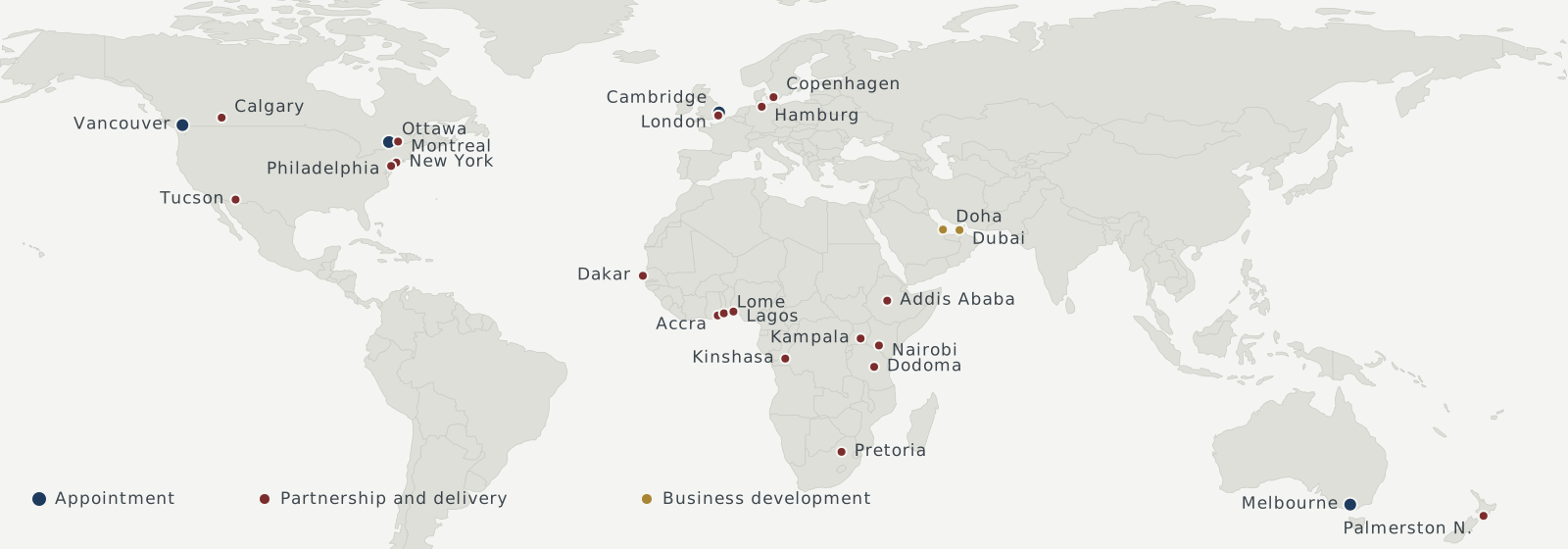
Twenty-five years of appointments, partnerships and commercial engagements across twelve countries. The record below covers institutional appointments, partnerships and commercial work undertaken by the principal, and is presented separately from engagements commissioned through Praxis Global.
Doctorate from the University of Cambridge. Honorary Research Fellow at Cambridge Judge Business School, appointed by the Faculty Board, and Associate Research Fellow at the Cambridge Centre for Social Innovation. Directed a postgraduate programme at the University of Westminster from 2002 to 2006 and lectured at City, University of London. Current research collaborations with UK colleagues. Business architecture and market analysis developed for a private higher education venture targeting the United Kingdom sector. Indefinite leave to remain.
Honorary Fellow at the Dilin Duwa Centre for Indigenous Business Leadership, University of Melbourne. Partnership agreements negotiated with Massey University's Te Au Rangahau centre and with Melbourne. Taught on an Indigenous MBA field school at Waikato Tainui College. Grant adjudication for the Marsden Fund, Royal Society Te Apārangi. Comparative research on procurement policy across Canada, Australia and New Zealand.
Fulbright Visiting Research Chair at the University of Arizona, and a Fulbright Community Leaders Award. Conference and symposium convening at the Academy of Management and the New School for Social Research.
Visiting Professor at the Nordakademie Graduate School of Business from 2017 to 2023, teaching leadership on the MBA. Current research collaboration with German colleagues.
Co-led a Mastercard Foundation supported research network linking Canadian and African institutions on youth employment and enterprise, convening scholars and practitioners across Senegal, Nigeria, Ghana, Kenya, Tanzania, Uganda, the Democratic Republic of Congo, Togo and South Africa. Co-organised a workshop at the University of Pretoria during African Knowledge Week. Ran an international business field school in Ethiopia. West Africa was a designated hub in an international education venture developed with a business school dean.
Negotiated an agreement in Saudi Arabia to deliver an industry-based MBA. Took an international education venture to partners in Doha, structured around accredited provision in Canada with hubs in the United Kingdom, West Africa, India and the Gulf. Represented senior university leadership within Team Canada at Expo 2020 Dubai.
Global music industry lead within Accenture's communications, media and entertainment practice, with engagements across Europe, Asia and North America for clients including Cisco, AT&T, Warner Music Group, SAP and BUMA/STEMRA. Earlier, a decade producing international theatre, arena and festival tours.

A working session in progress. Simon Fraser University.
Method
Diagnosis before recommendation. Measures agreed before the work, not after it.
A staged approach with measurement specified at the outset rather than assembled at the end. Observation is separated from judgement, confidence is stated, competing readings are preserved, and trade-offs are made explicit. Each phase produces a usable artefact and can be commissioned alone.
Artificial intelligence
Artificial intelligence changes the conditions under which organisations make decisions.
It is not treated as a separate practice area. It enters the work where it changes how decisions are made, how responsibility is allocated, how work is organised, or how value is created.
In institutional strategy that includes the implications for academic provision, assessment, research, organisational capability and institutional sustainability. In governance it includes the arrangements for adoption: decision rights, accountability, procurement, disclosure and review. In venture work the question is where artificial intelligence contributes to the product, the operating model and the basis of advantage, and where it does not.
The research behind it
The research examines what happens when people and generative artificial intelligence develop new ideas, products and ventures together. Each brings different capabilities and different limitations, and neither compensates for the other, so the pair produces possibilities, and errors, that neither would produce alone.
That matters because generating, testing and discarding options has become inexpensive. The question is less about producing possibilities than about deciding which are useful, which should be pursued, and who is accountable for those decisions. Artificial intelligence does not remove the need for judgement. It changes where judgement is required.
Behind this sits an MBA in management of technology and a senior management position at Accenture through the digital transformation of the media sector.
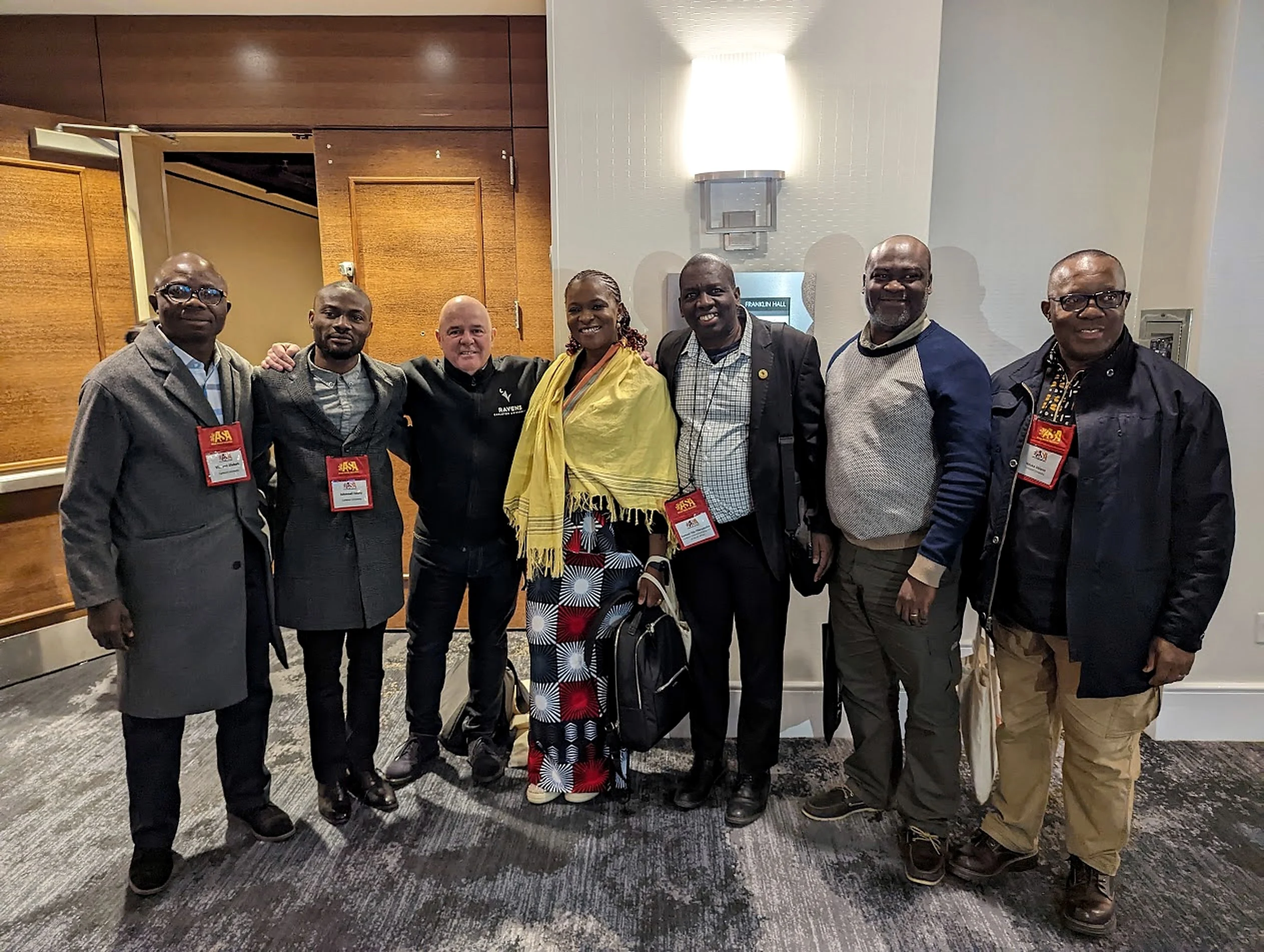
Research and enterprise network colleagues, African Studies Association.